Liner paper is highly recommended when installing on rough walls and paneling. Wallpaper has a tendency to move when the weather/humidity changes. When that happens, popping seams and possible peeling can happen. Installing a paper liner is the best way to guarantee that the seams will not lift.
Like a pad under a carpet or liner on your drapes, its unseen. It’s a best practice with certain wallpapers like grass cloth and rough surfaces but it can be optional. With grass cloth, 50% of my clients use liner paper and 50% don’t. The percentage goes up to 90% when installing on rough walls like stucco or paneling.
If you use liner paper, grass cloth will last for 30 years. If you don’t use liner paper, it all depends on whether or not the homeowner keeps their home humidity low, i.e., uses A/C all summer and humidifiers. So it’s possible there would never be a problem. That’s why 50% of people take their chances with no liner.
Wallpapering over rough surfaces or paneling is another story. If you want to be sure you won’t be fixing seams or corners every few months, it is best to use liner paper.
The decorating inspiration for the PBS “Mercy Street” TV series comes from the Carlyle House in Alexandria. While the show’s producers were unable to shoot at the real Mercy Street location in Old Town Alexandria, the set design and decoration is inspired from the actual Carlyle House. I was fortunate to work on the Carlyle House about five years ago. For decorating and TV buffs, watching this series is a pleasure of historic and decorating insights.
If you are interested in seeing the original building where the events of the Mercy Street show takes place, visit the Carlyle House. The house is on the National Historic Register.
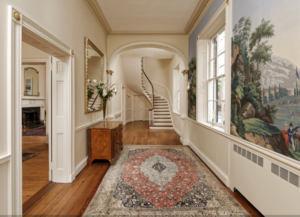
Several years ago I installed the hall mural in the Lafayette house in Old Town Alexandria. It is a Zuber reproduction mural of views of North America. This past week, Kathy Orton, wrote up a great article in the Washington Post about the house, its’ history and how you can now buy it for $6.8 million dollars. In October, 1824, Marquis de Lafayette visited Alexandria and lived in this house.